Female pattern hair loss
Female pattern hair loss explained: the early signs, the three stages, what causes it, and treatment tailored to you.

Written and reviewed by Shuna Hammocks, consultant trichologist (IoT no. 10060)
Last reviewed
What is female pattern hair loss?
Female pattern hair loss is the most common cause of thinning hair in women. You may also see it called female pattern baldness, androgenetic alopecia or, on older pages of this site, androgen dependant alopecia. They are all the same condition.
Despite the name, complete baldness in women is very rare. Instead, the hair on top of your head becomes finer and less dense, while the sides and back stay much as they were. It can start any time from your late teens, and it often becomes noticeable after a hormonal change such as having a baby or the menopause.
Not sure this is what you have? Hair loss in women explains how to tell the common causes apart.
The short answer
Female pattern hair loss is gradual, inherited thinning on the top of the head. The hair follicles there are sensitive to normal levels of androgen hormones, so over time they grow finer, shorter hairs. Your parting widens and more scalp shows, but your front hairline is usually kept. It can’t be cured, but it can often be slowed, and sometimes improved.
Early signs of female pattern hair loss
- A parting that looks wider than it used to
- More scalp showing on top, in bright bathroom light, sunshine or photos
- Hair that feels finer and won’t hold a style
- Thinning on top and at the crown, while the sides and back stay thick
- Thinning hair in your family, on your mother’s or father’s side
Female pattern hair loss doesn’t usually mean more hair falling out. The hairs on top grow finer, so they cover less of your scalp. Most women only notice once the hair on top has lost around a third of its volume, and it’s often a hairdresser or friend who spots it first.
You may also have another condition.
The stages of female pattern hair loss
Trichologists and doctors often describe it using the Ludwig scale, which has three stages.
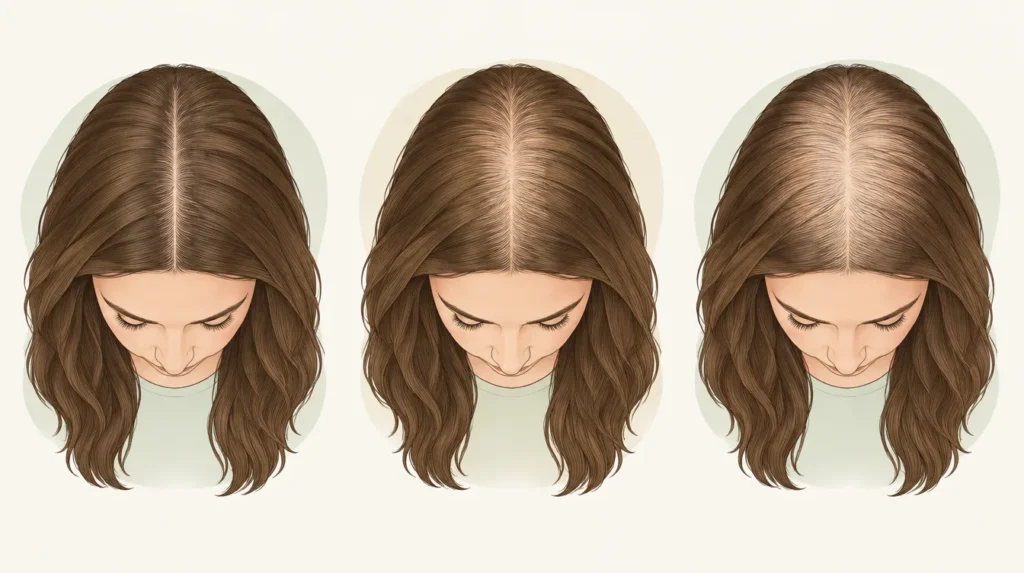
Stage 1: mild
Your parting looks a little wider and your hair has less volume on top. Most women notice it in bright light or photos.
Stage 2: moderate
The parting is clearly wider and more scalp shows across the top of your head. Styles fall flat.
Stage 3: advanced
The scalp is easy to see on top, though the front hairline is usually still there.
What causes female pattern hair loss?
Two things work together. You can’t change the first, but knowing about them helps you avoid wasting money on things that can’t work.
- Sensitivity to androgens
- Hormone changes
What doesn’t cause it
- Washing your hair. The hairs you see after washing had already stopped growing, so how often you wash your hair doesn’t change the amount you lose.
- Poor circulation. Scalp massage feels lovely, but it can’t change how sensitive your follicles are.
- Hats and hair bands. They don’t affect hormones. Tight styles can cause traction alopecia, which is a different condition.
Female pattern hair loss treatment
There’s no cure, but treatment can often stop the thinning getting worse, and for some women it improves density. Starting early matters: it’s easier to keep hair than to regrow it.
Treatments exclusively for you
I will consider your medical health, the medicines and supplements you are taking and your scalp tissue tolerance before deciding with you what you can manage to do at home. I would be available by email, text or phone to support you while you get into the swing of what to do.
Scalp care made for you
A calm, healthy scalp gives any treatment its best chance. Your plan sets out how to wash, what to use and which topical treatments suit you.
How long does it take? Hair grows about a centimetre a month. Each person and case varies in improvement window. Some are more compliant than others to suggestions I provide. Most feel their general health and mental health improve alongside the hair too.
How I diagnose female pattern hair loss
Several conditions can look like female pattern hair loss, including shedding, thyroid problems and, less often, scarring hair loss. At a consultation in Forest Row we spend about an hour finding out which it is.
- A full history: your family, periods, pregnancies, contraception, HRT, medication and diet
- A close look at your scalp, comparing the hairs on top with those at the sides and back
- Blood tests if your history suggests they’re needed, through your GP or privately
Please bring a list of your medicines and supplements, with doses, to your consultation.
Questions about female pattern hair loss
If yours isn’t here, send me a message and I’ll get back to you.
Is female pattern hair loss the same as androgenetic alopecia?
Yes. Female pattern hair loss, female pattern baldness, androgenetic alopecia and androgen dependant alopecia are names for the same condition.
Is female pattern hair loss reversible?
It can’t be cured, but treatment can often stop it getting worse, and some women regain density. The earlier you start, the more hair there is to keep.
Will I go bald?
Very unlikely. Women with this condition almost always keep their front hairline, and the sides and back stay much thicker than the top.
Does PCOS make female pattern hair loss more likely?
It can. PCOS often raises androgen levels and/or sensitivity to them, which can speed up thinning if you’re already prone to it.
Can the pill or HRT make it worse?
Some can, in women who are prone to it and are taking a certain class of hormones. I can help you have that conversation.
At what age does female pattern hair loss start?
Any time from the onset of puberty right through to the menopause. We will cover all of this.
Let’s find out what’s going on
Book online at a time that suits you. If you have a question first, send me a message.